Flashforge Dreamer Reviews: See Why 0 Shoppers Rated It 0 Stars!
We gathered 0 reviews of the Flashforge Dreamer 3d printer to answer one thing: Does it live up to its 0/5 score?
 Supermod
 Moderator
 Recaptor
Flashforge Dreamer Review: A Beginner-Friendly 3D Printer Built for Versatility
When stepping into the world of 3D printing, finding a reliable, user-friendly device can make all the difference. The Flashforge Dreamer stands out in the consumer-grade FDM/FFF category, designed primarily for beginners yet packed with features that support prototyping and engineering applications. Released in 2014, this printer balances accessibility with technical specs appealing enough to accommodate multi-material projects. But does it really live up to its specifications on paper, and why has it remained relevant in this competitive niche over nearly a decade? Understanding its key specifications will help us unravel its practical value.
Detailed Specs & Features
On paper, the Dreamer offers a solid build volume of 295.4 cubic inches, provided by its build dimensions of 9.1 inches in width, 5.9 inches in depth, and 5.5 inches in height. This footprint suits hobbyists wanting to print moderately sized models or prototypes. The unit itself weighs about 27 pounds with dimensions of 18.4 by 12.6 by 15 inches, making it compact enough to fit on standard desks with a space requirement of just 1.8 square feet.
The printer's dual extruders support multiple filament types, including ABS, PLA, HIPS, PVA, and flexible filaments, which broaden creative possibilities. Its two extruders allow multi-material printing up to two materials simultaneously, enhancing part complexity and color vibrancy. The extruders operate via a direct-drive mechanical system, catering to intricate filament handling and consistent extrusion. In terms of power, the Flashforge Dreamer accepts a broad 100-240 Volt input through an internal power supply, drawing about 320 Watts during active printing and dipping to 30 Watts in idle mode, indicating some energy efficiency by design.
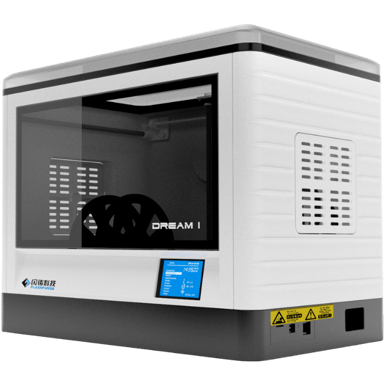
However, it lacks a dedicated energy-saving mode, which could affect long-duration energy expenses. Visual interaction comes courtesy of a 3.5-inch touchscreen with a reasonable 320x240p resolution, providing tactile control without overwhelming complexity. The frame is fully enclosed with carbon filtration, affording safer indoor operation by controlling emissions; a critical concern for users sensitive to air quality during ABS printing. Manual bed leveling is standard practice here, supported by a metal, smooth-surfaced, removable build plate, making model removal and maintenance more approachable.
User Experience & Performance (Based on Specs)
Design & Build
The Dreamer's Cartesian mechanical structure, combined with belts and rods for motion, follows a proven blueprint tuned for precision. Closed frames provide twice the benefits: stability for printing accuracy and a reduction in ambient temperature fluctuations, which is important for materials like ABS. The printer's weight and mass distribution lend it a sturdy feel without sacrificing portability for desktop placement. The inclusion of chamber lighting (white) and a filament runout sensor further helps users engage smoothly with the machine and avoid unexpected print failures.
Performance
While the official max print speed is rated at 200 mm/s, effective operational speed is around 50 mm/s according to measured specs, which is standard for consumer-grade machines in this class. Print accuracy boasts a minimum layer resolution of 100 microns, enabling fairly detailed models for prototyping purposes. The heated bed can reach up to 230°C, supporting filament adhesion for ABS and related materials, though it requires manual calibration for the first layer. Nevertheless, the printer provides features like print recovery after power loss, meaning long prints can often be salvaged; something not all beginner machines offer.
Camera & Display
The touchscreen interface, while limited in resolution at 320x240 pixels, offers practical control over print jobs and filament management. Notably absent is a built-in camera, so remote visual monitoring relies on external solutions via Wi-Fi connectivity. Speaking of noise, operating levels hover around 50 decibels, perfectly tolerable for home or studio environments, and idle noise is even lower at 35 decibels; quiet enough not to disturb daily workflow.
Extra Features
Connectivity is flexible, including USB, SD card, and Wi-Fi access, combined with remote monitoring capabilities. Proprietary FlashPrint software, alongside compatibility with other slicers like Simplify3D and Slic3r, empowers both novices and more advanced users to optimize print paths. The printer can be integrated into print farm management systems and supports multi-printer fleet control, making it scalable for small businesses or educational settings. Firmware upgradeability ensures longevity and adaptability even years after release.
Pros & Cons
Pros
- Dual extruders enabling multi-material projects
- Closed frame with carbon air filtration for safer indoor use
- Moderate build volume is sufficient for most hobbyist needs
- Print recovery and filament runout sensor to reduce print failures
Cons
- Manual bed leveling requires user expertise for optimal adhesion
- Lack of a built-in camera limits internal monitoring options
- No energy-saving mode, which could impact long-term power consumption
- Relatively basic touchscreen display resolution
Price & Value for Money
The Flashforge Dreamer is priced at approximately $1099 at FlashForge.com, which, given its 1-year warranty and robust dual-extruder system, feels quite justified. For beginners opening their first 3D printer box or small workshop environments requiring multi-material capabilities, it hits a sweet spot of price versus practical features. Although some newer models might offer automated bed leveling or enhanced visual monitoring, the Dreamer's balance of workspace, air filtration, and effective print recovery keeps it competitively relevant without pushing budget thresholds.
Quick Take
In short, the Flashforge Dreamer merges beginner-friendly design with advanced capabilities like dual extruders and enclosed carbon filtration. If we look at the numbers alone, it's 295.4 cubic inches of build volume combined with a varied filament compatibility, making it a versatile entry-level printer built for more than simple hobby prints.
Closing Recommendation
This 3D printer appears to perform best for users who prioritize safety, dual-material printing, and manageable maintenance in a consumer-ready package. While not without limitations, such as manual bed leveling and a modest touchscreen resolution, it helped pioneer a class of accessible FDM printers with thoughtful features that remain valuable. For those starting or scaling small 3D print projects, the Dreamer helps users achieve quality prints without overwhelming technical barriers.
Verdict
Rating: Based on the specifications and overall feature set, we believe Flashforge Dreamer deserves 4.2 out of 5.
- Winner Feature => Dual extruders with multi-filament support make it versatile and creative.
- Needs Improvement => Manual bed leveling and lack of a built-in camera slightly limit user convenience.
Reviews 0
The good, the bad, and the brutally honest.Average Rating


More 3D Printers 453
Unlock more awesome finds.